Day to Day, No Timeline to Return:

Sports Prevailing Through Media; Covid and The NBA Bubble Experience

Sean Hakim, University of Pennsylvania

—December 2025—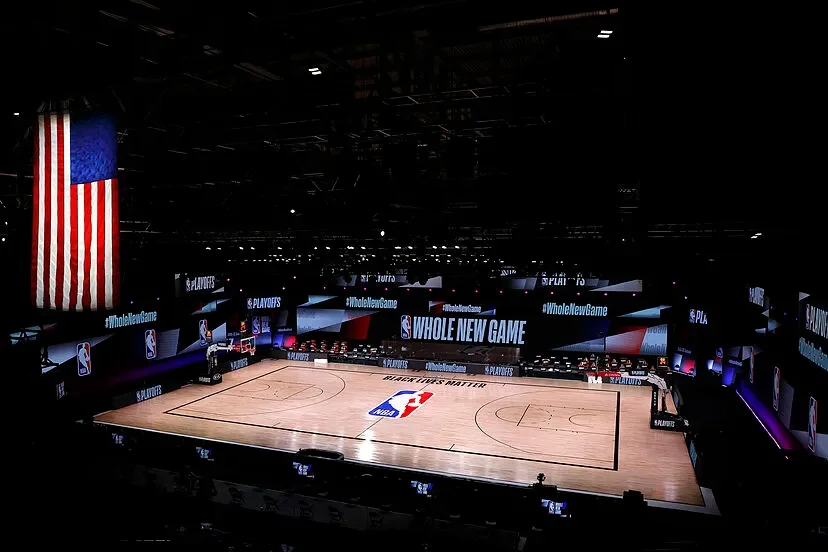
Figure 1
ESPN Wide World of Sports Complex in Orlando, Florida — site of the 2020 NBA Bubble. Note. Photo by G. Goebel (2016), usedunder CC BY-SA 2.0.
The Philadelphia 76ers tie the game with seconds to spare in Game 7 of the Eastern Conference Finals in Toronto: Jimmy Butler drives down the lane and makes a layup, barely evading Serge Ibaka’s block attempt. The Raptors call a timeout with a little over four seconds to spare, moving the ball down court while drawing up a play.It’s May 12th, 2019, and I’m currently living in Atlanta, Georgia, having recently graduated from Georgia Tech. I’m watching the game with all three of my current roommates in our apartment in Midtown; our floor to ceiling windows provide a clear view of campus to the left side and Midtown to the right. My roommates had turned into hecklers, seemingly rooting against the Sixers, for the duration of the game. After Jimmy Butler, aka Jimmy Buckets, tied the game, they couldn’t help but start cheering in disbelief. I, being dramatic, leave the room and walk down the hall, knowing this is too good to be true, pacing like a fool-sports-fanatic whose mood is directly impacted by the success of my teams. This was one of those moments where although something great happened, you can’t help but know you’re about to be humbled, disappointed, and may I add, broken. I enter the room right before the refs resume play. Standing behind the couch, one of my roommates approaches with a big grin; again, in dramatic fashion, I wave him away to give me space, the original social distance.

The ball is inbounded to Kawhi Leonard. He is the last person any Sixers fan wants with the ball right now, but it comes to no surprise that he’ll be taking the last shot. He dribbles the ball around the perimeter and launches a three in the far corner, over both Joel Embiid and Ben Simmons who defend him well, landing out of bounds. The buzzer sounds while the ball is in the air, with Kawhi squatting, maintaining intense eye contact with the ball. Joel, Ben, everyone in attendance, all of the fans watching on TV, stare in terrific amazement as the ball bounces on the rim, not once, but four times, before going in...PAIN! The Raptors team swarm Kawhi, the crowd goes insane, my roommates go insane (like relax you have no stake in this), and the Sixers walk themselves off the court. Better luck next year…

Sports Media from Within

The following month I started my job with Turner Sports, located on the historic Techwood campus. The campus, with several buildings, large courtyards, a huge fountain, major studios, control rooms, and underground-connecting-tunnels, overlooked Midtown Atlanta and Georgia Tech’s campus. I had successfully graduated from GT to spend five days a week directly next door. I joined the CSSU, Creative Services Sports Unit, an internal agency that created all types of content for the Turner Sports system. We were home to editors, designers, producers, project managers and so on, working with Turner marketing, sales, and legal teams, interfacing with national sports leagues, sales partners, and talent agencies. My first project was managing creative for our UEFA Europa League coverage. I was tasked with working with producers and editors to create commercial content promoting our live broadcasts. Within a month I shifted my focus to my first season-long property: NBA on TNT. I was invited into rooms to ideate with our Coordinating Producers, Creative Directors, and other Senior Producers, strategizing for commercial campaigns to promote the 2019-2020 NBA season on TNT. To me, this was about as cool as it can get: I was working in sports, in a major operation that is home to Inside the NBA with Shaquille O’Neal and Charles Barkley along with co-hosts Kenny Smith and Ernie Johnson, and I had the opportunity to help spearhead the creative that would be seen across the country. I’d predominantly work with the NBA marketing team to align on creative requirements for our campaigns and liaise with our internal creatives to bring visions to life. I was excited to be a part of my first project lifecycle with TNT’s opening night as my first major tentpole.

Getting an inside look on how creative visions come to life was maybe the most rewarding part of my role. I really got the chance to see all the moving parts behind creating commercials, documentaries, billboards, digital ads, on-screen graphics, and more; I collaborated with all of the teams that came together to make this happen, getting firsthand exposure on the logistics behind approvals and league restrictions, legal oversight, and budgetary limitations or affordances. At the time, all personnel reported to duty at the office; we met in person, collaborated in person, and checked-in in person. It was not conceivable to operate any other way than being there in person. Emails were used for one-off questions and overall approvals for documentation purposes, but face-to-face communication was the norm. I would approach an edit room to align with our editors and producers on weekly commercial creatives, internally known as Topicals. We would sit together to discuss endpage revisions due to logo specifications or player inclusions/removal. It wouldn’t be unusual to be in an edit room until 8 or 9 PM to ensure timely delivery of our urgent assets. The show must go on.

Fast forward to February 2020. I am well into my first season managing promotional creative for our NBA on TNT coverage. We’ve launched our commercials for NBA All Star on TNT and have been working towards our March Madness coverage promotional materials. At this point I also have had the pleasure of collaborating with our sales teams for projects with Intel, AutoTrader, and State Farm. I’d shifted some of my attention to digital creative and was feeling my impact department-wide. At this point, I felt as though I made a good decision accepting this role. Media is ever-present anyway, so I considered this industry to be a safe bet for my career, that was, until Covid-19. The news of the spread was slow and shared unconfidently, activatingconcerns of ambiguity and uncertainty. As employees of a massive organization, we would receive trickle-down information on potential implications, while getting mass-email blasts from upper management. Considering the active seasons we were broadcasting, I had assumed we would hear information faster than the general public, but quickly noticed that would not be the case. As an early-career professional, I was not sitting in on the conversations with the leagues around decisions regarding the NBA season and March Madness tournament plans; I continued business as usual and awaited further direction.

Anyone following the NBA in March of 2020 remembers Rudy Gobert of the Utah Jazz cynically showing a lack of concern for the seriousness of Covid and mockingly touching all of the microphones during a press conference before a home game against Toronto. Just two days later, news was publicly released that an unannounced player of the Jazz had tested positive for Covid-19 and the league was suspending the season. On Tuesday, March 10th, just a day before the season was suspended indefinitely, I worked late in the office. At the time, the CSSU was located next to the NBA Digital team, on the first floor of our building. There were no windows in our area, so the room always had a basement feel; that day the dim lighting felt more eerie than usual. Several of us on the team were trying to get information regarding the rumors that were circulating around games potentially being cancelled. Leaders on our team told us to grab our personal belongings from our desks and head home, with the expectation that we would be working remotely for the next two weeks. No other information was shared at that time, but there was a sense of gloom and unease in the air. This would be the last time I would set foot in the office for a year, aside from one time, a month afterMarch 10th to grab an extra monitor, which was a whole ordeal due to strict Covid protocols. On March 12th, the National Hockey Association and Major League Soccer suspended their seasons as well, Major League Baseball cancelled spring training games and delayed the start of its season, and the NCAA cancelled March Madness (Holmes & MacMahon 2025). Val Ackerman, Big East commissioner told ESPN: “This has been the most extraordinary stretch of days I’ve ever had or ever seen in my 30-plus years of working in the sports business.” The pandemic would go on to combine $14 billion in losses across the NBA, NFL, MLB, and NCAA (Wingard 2021).

A lack of knowledge around the severity and potential longevity of the pandemic was shared among most people. “The event that made Americans realize that Covid-19 was not going to disappear within a week or two was not President Donald Trump’s announcement of a partial closure of the skies for flights from Europe that day, but rather a decision by NBA Commissioner Adam Silver to stop the NBA season” (Galily 2021). Sports are really that big; Galily claims that sports don’t operate in isolation from broader society. Sports are also small; small in the sense that many individuals play miniature parts in the overall creation around the events and broadcasts.

Dealing with the Unknowns

In professional sports, particularly looking at the NBA and NFL, there are player distinctions heading into each matchup. The terminology around player status consists of Active, Day-to-Day, Out, or Injured Reserve (there are a few other distinctions I am not mentioning). Active implies the player is available and will suit up for the game. Day-to-Day means the player is nursing an injury, ailment, or personal matter; but the player is expected to be back soon, with no specific timeline as to when. Out implies the player is not available to play due to injury, personal matter, or due to the league or team’s decision to bench the player. Specifically to the NFL, Injured Reserve means the player has been removed from the active roster, sidelining him for at least four games; the benefit of placing a player on the Injured Reserve list is that it frees up a spot on the 53-man active NFL roster.

I consider March 10th, up until the news of the NBA Bubble arose and was approved on June 5th, to be the beginning of NBA’s Day-to-Day distinction. I also personally owned that distinction as well as an employee in the lens of managing the NBA on TNT promotional efforts for the season. Much of this time period, I was waiting for news, finding new ways to engage with my coworkers virtually, exploring ideas for future seasons across Turner’s sport properties. Considering news could be released any day on the resumption, we were in a Day-to-Day state, ready to play when cleared. Sharing a similar sentiment, Torrence Wilson, a colleague of mine who served as a Writer/Producer for the CSSU in 2020, expressed uncertainty about the situation, “We don’t know what [comes next] but games are postponed. [The] NBA was waiting and seeing what the health experts would say. Really we were just taking things Day by Day. [With the] unknown timeline for return, I didn’t see Kyle Wells (another writer/producer on the team) for a year.” We really had no idea at the time that we were leaving the office indefinitely–a situation that feels shocking looking back at it.

Torrence was one of the first people to take me under his wing at Turner, inviting me along to collaborate with him on some passion projects, one in particular being the Martin Luther King Jr Drive initiative. He had a beautiful concept for a season-recurring feature to air during our MLK Jr Day NBA on TNT games where we would travel to the cities of the home team and bring to light MLK Jr streets, an opportunity to showcase the environments and neighborhoods in which these streets lie. The vision to include players, interview councilmen involved with transitioning the street names to MLK Jr Drive (often previously named after confederate soldiers) and interviewing locals with historic businesses with MLK addresses, was actualized and carried out in Atlanta for the first, of hopefully many features. Prior to traveling around Atlanta and getting content for the feature, we partnered up and pitched the idea to the Creative Council, a group of people across different business units at Turner that were brought together to do just that, design out-of-the-box concepts for creative opportunities. I was invited to join by then Associate Creative Director of TNT Sports, Tyler Lassiter, who oversaw several producers, Torrence included. Torrence was generous enough to share his wisdom as a producer with me, bringing me along to the shoots to see how a vision comes to life, which would be my first experience participating in the creation as opposed to just managing the project. Unfortunately, one of the negative impacts of Covid was the derailment of progress made prior; the Creative Council fell apart and the MLK Jr Drive Initiative would be a one time thing.

The job security was a resounding concern for all media personnel during the coronavirus pandemic. Torrence recounts how Covid affected all sports we had airing at the time, which in turn left people unsettled across our department. Unfortunately, these media companies cut back on personnel with the drop-off of events to cover, but “Fortunately for us, television was the main source for entertainment at that point. The ratings for many shows went up during Covid, it just didn’t take the same amount of people.” Jonathan Scott, another Writer/Producer for the CSSU, mainly leading NBATV efforts, found out the news the same way everybody else did. “Once we heard [the league] was shut down, I was concerned about my job, less about sports.” Tyler Lassiter, our previously mentioned Associate Creative Director, was most concerned about March Madness. At this point we had set everything up for March Madness, with the Final Four happening in Atlanta, the unknowns around whether the tournament was going to occur were profuse: “Every other sport was on the periphery. You weren’t getting a lot of information at first. Nobody knew, it was a weird time. It was a speculation on when, if, how.”

March Madness is the last opportunity for many young athletes to showcase their talents, with the hope of getting to the NBA, play internationally, or experience the glory of being a champion. For them, the crisis of the tournament cancellation, not postponement, was immense and overwhelming. Their chance to be on the biggest stage, with the largest audience, was taken away from them at the hands of a disease outbreak, something completely outside of their control. No amount of training or practice can prepare someone for a lost opportunity, especially one that you’ve spent your whole life working towards. From the perspective of a media company, such as Turner and CBS, March Madness coverage is an absolute powerhouse for viewership ratings, being one of the most lucrative broadcasts for their businesses. It is not an easy decision to accept a cease and termination of the tournament, with contracts implicated.

Not only would the cancellation of March Madness and the postponement of other sports impact the lack of audiences tuning in, but it would impact partnerships and deals around advertisements that were specifically made for these large sporting event broadcasts. The advertising revenue was directly hit; weakened sponsor value proposition, due to the unpredictability of seasons causing difficult planning, shifted brands towards spending on digital advertisements: fewer live events means fewer premium ad slots (Ball State University 2023). During this downtime, we noticed the destabilization of sponsor exposure value, and the loss of revenue that came from the drop in viewership and sponsorship deals needs to be recovered somewhere. Live sporting events reliably draw big audiences; so without them, broadcasters that depend on those programs had to look for alternative programming to fill their schedules (Coche & Lynn 2020). Layoffs became all too common during Covid. I am grateful for maintaining my salary and position during that time of such uncertainty, while many others were not as fortunate.

Media personnel of all types felt the impact of the pandemic and the reconfigured workforce. Job security in mind, our team’s downtime was spent working on hallway projects as we called them; these were tasks that have been on a list but never tackled because of our busy schedules and prioritized matters. My manager at the time, Breanne Espina Kempner, emphasized the importance of staying busy by posing the question, “What can we keep people working on to keep everyone employed?” For those with roles more directly tied to live broadcasts, ongoing work was harder to come by. Broadcasters specifically reported their work disappearing. The suspension of live sports events (game cancellations, stadium closures, live content diminishing), disrupted their usual job duties (interviews, game coverage, feature segments), directly impacting their job security. For live commentators at large companies, there were workarounds, but the local commentators felt the struggle more directly; “Many local television sports broadcasters found themselves having to adapt to not having games to cover or athletes and coaches to interview” (Hull 2025). Human resource management became a function of all those who served as people managers across the industry.

Within a couple days of the news, every business unit touching live sports was heavily involved with creating contingency plans. NBATV, being a 24 hour broadcast dedicated to NBA content and games, did not have the luxury of deferring to other partner shows. Our then-VP of NBATV and Executive Producer, John O’Connor, mentioned that his team swiftly came up with the plan to run gametime shows remotely and strategized to get the crews set up at home. In collaboration with Kiswe, a streaming partner, NBATV helped create an online show that was taped and then posted to master control to air. A new format of television was coming to life, one that involved interviewing former players and stars who would get equipment sent to their homes and receive walkthrough instructions on how to properly set the scene and prepare the tech. These at-home sessions allowed a continuation of content to be created, preventing a major gap in new programming. Aside from those opportunities, NBATV chose to run classic games on their network while figuring out what comes next. Torrence Wilson, CSSU Writer/Producer, spoke about needing to produce long-form content to fill the void of games lasting hours: “There was a thirst for any type of entertainment, especially in the sports world, and with the current players.” Heavily utilizing Zoom, the team would run cutdowns of games with NBA talent and hosts along with star players like Zach Lavine to discuss their teams’ gameplay.

The Director of NBA Marketing, Anya Johnson, discussed the need to scenario-plan, staging questions to necessary parties like “What are we going to do if gameplay doesn’t return? What if it does?” The NBA on TNT marketing team shifted efforts towards three scenarios, creating budgets for each in order to be prepared in case of a return to: full capacity (with fans), modified capacity (without fans), or the season’s outright cancellation. If there was to be a return, one of Anya’s main interests as marketing director was getting an understanding of what the schedule would look like. Within only a few weeks, fans were desperate for the return of the sports they love; as Anya put it best, “People were going through sports withdrawal.”

For producers, the focus was maintained on creating content. Jon Scott (Writer/Producer) recounts being fortunate enough to have collected footage prior to the abrupt transition to remote, enabling the continuation of his efforts on a piece with Shawn Kemp and Gary Payton. He spent his early remote days working in the garage while his kids were playing, receiving footage and workout videos from teams to continue generating new material. This remote work was an unfamiliar process for many who were forced to work from home. Production teams accelerated remote production models, like the Remote Integration Model (REMI), ensuring home setups were viable and effective enough to produce quality content efficiently across creative teams. The new types of content made during a time where the whole world participated from home required creativity and perseverance through the limitations. Tyler (Creative Director) mentioned the desire for things to look perfect and continue to be top tier, while accepting the new type of production, “You had to figure out what you were willing to live with.” The audience watches with a critical eye, so the responsibility and pressures to produce at the highest level was still on the creatives, even with the limitations.

In the overarching industry, the pandemic served as a tipping point for remote production, something that had been gradually adopted but now a necessity. Roxane Coche and Benjamin Lynn, researchers from University of Florida, point out three obstacles around the initial surge of remote production: technical communications, infrastructure costs, and inertia in a traditional industry (2020). The pandemic forced rapid change in workflows and creative strategy. Those directly working in sports, however, continued to find ways to make original works.

Shifting Media Landscape

Briefly stepping aside from sports and addressing the media as a whole, there is much to be said regarding the consumption of media while people are confined at home. There seemed to be a significant increase in the consumption of broadcast television, streaming services, and online media platforms during this unprecedented time. Television shifted from being just a source of information and entertainment to a structural anchor in people’s lives, when routines were disrupted, to maintain a sense of normalcy. While major live broadcasts halted and reruns took over television programming, streaming services began to surface as a preferred medium. In the Michigan Journal of Economics, Shayna Korsh positions the pandemic as a catalyst, rather than a creator, of the shift from traditional live television toward internet-based streaming platforms (2020). She claims that consumers were already moving away from linear TV, but lockdowns distinguished streaming services as the primary source of entertainment for millions. The nascent rise of streaming was a cultural transformation rather than a temporary spike, with the reason being that entertainment consumption surged and streaming services benefitted disproportionately from the surge; this can be attributed to their unlimited on-demand access and expansive libraries. The time spent on streaming platforms more than doubled from March 16-22 in 2019 to the same week in 2020, totalling 156.1 billion minutes in the 2020 week (Barney 2020). To put things in perspective, once lockdown was official, Netflix stock raised from $298.84 on March 16, 2020 to $439.17 by April 16, 2020 (NASDAQ, 2020). Still, prior to the pandemic, consumers spent an increased amount of time streaming TV, rather than watching live broadcasts. Shayna makes her point clear that television won’t disappear but that the pandemic has irreversibly changed media consumption; therefore, media companies need to be ready to adjust. Many media giants began putting more weight and effort into their streaming services and catalogues. Turner, which became WarnerMedia, then Warner Bros. Discovery, started utilizing HBOMax to generate revenue during the pandemic, through rebranding efforts, a large archival catalogue, and eventually streaming sports.

Broadcast networks had been challenging the same competitors for years; now they faced competition from tech companies that created media services. Many broadcast networks followed suit and created or acquired their own streaming services; the dynamics of Hollywood shifted. Kate Fortmueller did a deep dive into the shifting models of media production and consumption in her book on the Hollywood shutdown. She discusses the legacy studios and networks branching existing broadcasts into streaming apps. This is largely a forced hand for the legacy studios due to the record 1.7 million cancellations of cable subscriptions in 2020’s Q1 and 1.5 million cancellations in Q2 (Fortmueller 2020). For HBOMax, the library content was not enough to compete, new releases and live sports became a main focus for competing in the market: a strategy shared by most streaming services to attract and retain new viewers.

Inside the Bubble

Similarly to how news was circulated around the postponement of the NBA season, news of a concept coined the “Bubble” began making its rounds. There was a lot of speculation around what it was, what the needs would be from a media standpoint, and how it would look like for players and fans. Unless you had direct contact with the staff at the NBA, and they were in a position to share information, you were about as unaware as anyone. As we started getting a better understanding of the NBA Bubble, there was a mixture of relief for the return of the season and concern for its success. Our initial understanding was that the NBA would be returning in a contained environment in Orlando at the Wide World of Sports, one of the Disney World parks. All players, coaches, and media personnel were to be housed in hotels with many restrictions; the rest of the details were to be uncovered in an ongoing manner–aside from one of the biggest catches: there would be no fans. The time between receiving information and needing to have content prepared is always tight, but the preparation period was tighter than usual. My manager at the time, Bree, worked closely with our creative directors and knew the onus would be on our team to actualize products at any moment. She acknowledged the stakes, asking, “Who has the actual information? We have work to do!” Aside from planning efforts on how to promote such a novel and revolutionary sport experience, our team needed to assign on-ground support at the Bubble.

Tyler, our Associate Creative Director at the time, began asking for volunteers to lead our Bubble efforts. At the time, I think it was understood that this could be a once-in-a-lifetime opportunity, a potential game changer for one’s career, all with the caveat that the work was ambiguous and, most importantly, the duration of being in the Bubble was unknown. We had to send one producer and camera crew to capture what needed to be captured; everybody was building the ship as it was sailing. Jonathan Scott jumped at the opportunity, knowing he’d have to wear multiple hats while not knowing exactly what the scope entailed.

Upon arrival, Jon Scott was immediately met with the reality shock that was the Bubble. The media teams stayed in one area while the players stayed in another; however, everyone coexisted in the same “town” creating a dynamic that blended the coaches, players, and media personnel in a more intimate way than usual. There was a checklist of things needed to be done in order to circulate around the campus, with a failed test requiring a visit to the doctors. An interesting and surprising report was that the upkeep workers in the campus didn’t actually stay in the Bubble. The rigorous testing took its toll on media personnel, Jon included, who personally took 106 tests while in the bubble, accepted his fate now in 2025, “My nose is fu****!” Before entering certain zones with players testing was required; personnel would have to wait in a line, fill out a form, and scan into areas with bracelets; if the bracelet scanned red it either means the test came back as a failure or a need to retest.

In the early days at the Bubble, Jon Scott felt like a guinea pig. He arrived before the players, spending time acclimating and getting acquainted with equipment that he would normally work alongside but not operate himself. He was still looking for guidance from our lead Drew Watkins, who was our CSSU Creative Director and Turner Sports VP at the time. Jon told me that Drew candidly shared in conversation with him, “Dude, we’re taking guidance from you. It’s on you, we’re not there.” The pressure was on, along with the chance to hero the efforts for not just the CSSU, but many Turner Sports business units that touched NBA on TNT. For what felt like a long stretch, Jon Scott was there with the reporter and practically nobody else; he was the only producer there at the time, reporting daily to Tyler Lassiter. Once the players arrived and practice schedules were released to the media teams, it was game on for him and his lean team. Reflecting on his interactions with the league, he shared, “You’d see LeBron riding around on a bicycle, [one time] Kawhi dapped me up. We lived there, and there were no entourages, dorm-room style. We had a chance to interact with players.”

Everyone who was isolated on the campus was tested in more ways than just Covid screenings. For Jon, it was tough to be away from his family for so long. He spoke about being away from his son, who loved basketball, and recalled him shutting off and not watching basketball during his time there. The opportunity came with sacrifices; for media personnel and players alike, it was a test of mental fortitude. The family separation, bouts of depression, constant replays of the same music, and forced isolation, all had a resounding impact on those confined to the campus. Jon Scott related to the coaches, mentioning a walking routine he embedded in his days that involved him aimlessly roaming, passing the same coaches daily. A painful reality of privilege imbalances came when players were granted access for family visitors but media personnel were not given the same allowance; Jon Scott managed, “I know one time coach Spo saw me crying and he started beating his chest. Those are the bonds you have forever. You shared cool moments with different people.” These are moments where players, coaches, and media personnel all relate, temporarily delaying the traditional team and media dynamics.

Overcoming the overwhelming adversity the Bubble created for in-person staff, Jon Scott embraced the opportunity, both acknowledging that he knew he was a part of something that could be very successful while also not wanting to be boastful about his experience. He made himself serviceable to different teams, with many relying on him. He went to as many practices as he could to capture moments, making it his duty to overdeliver, “I was in a privileged position; other people weren’t taking advantage of it and wanted to go home, for good reason.” Jon served the entire duration of the Bubble for the CSSU and Turner Sports organization, while other media companies rotated out their personnel. The intent behind keeping Jon instead of sending a new team was the expertise and relationships he formed while there; committing Jon Scott for the long haul meant no transitional periods where progress could be slowed.

The close corners of the Bubble meant being on the inside for Jon Scott. In one instance, LeBron was casually walking down the hall and Jon, instinctually, captured the moment on video, leading to a citation from the commissioner’s office saying that wasn’t permitted. The NBA legalized weed for the Bubble, which is illegal in Florida. Jon, rehashing events shared, “Guys was tokin!” The players had a meeting and agreed this should be allowed. There would be alcohol runs as well with boxes andcrates delivered; anything to ease up the vibe. The luxurious lives many players lived were temporarily diminished, so the league chose to be flexible around player requests. Being a star player with the biggest salary didn’t mean as much in the Bubble, making the experience one with reduced egos and more focused on one thing: ball.

More than Basketball

Something I didn’t address much was the simultaneous social justice movements occurring, actually stalling and cancelling games in the Bubble with teams refusing to suit up and play. Jon got a closeup view of players in action, setting aside sports for social justice support, witnessing players standing outside of the locker rooms saying they weren’t going to play. This sheds light on the importance of players’ voices and actions, especially when it comes to being social actors, ones that people look to and follow. As Yair Galily, an Associate Professor and Behavioral Scientist at Reichman University, explored, athlete activism shifted power dynamics, showing that players were more than talent assets to be marketed, but agents who could influence league narrative, media coverage, and fan engagement (2021). Moments like this redefine and reshape how the league markets itself, how fans interact with each other and with media, and how media companies focus their content strategies to more storytelling and social value alignment. This is particularly true during crises; sports brands and leagues are responsible for participating and recognizing their existence within broader social contexts (Galily 2021).

Outside the Job Description

As a producer, Jon Scott’s hotel closet metaphorically filled up with the multiple hats he’d have to wear in his day-to-day activities. He would learn to set up stuff on his own, shoot the interviews himself, operate and take apart the technology, all while ensuring he got top-notch content for the team, operating remotely in Atlanta. The pressure of performing daily for the produced and live content was heavy, but he liked stepping out of his comfort zone. Nobody cared that it was Covid, the team still needed to maintain the standards we had established pre-Covid and Jon delivered. Now he can relate to any department, appreciating what its members do. After leaving the Bubble, Jon’s network increased tremendously; he is now on a first-name basis with every team’s PR, something that has continued to come in handy in his work today.

Back in Atlanta, the team was working tirelessly to bring the shows and materials to life. Marketing something as new and unusual as the Bubble would be a demanding and complicated ordeal. Anya Johnson (NBA Marketing Director) knew this was a marketing opportunity: “We want to make sure fans know we’re back but how can we use this as a moment to infuse hope? We were so used to seeing things shut down around us. The return of sports was a signal [that] a sense of normalcy could happen.” The Bubble forced people to become more creative in how they distribute content. Johnny O (NBATV) shared additional insights: “It made people think outside the [Bubble] more. It forced people into a technology space.” Teams got into a rhythm where they realized they don’t need to be in the same room to create content and get the content out to the masses. In promoting the league, the race was on to tell the masses it was resuming and, most importantly, how it was coming back. One of thefocal points was on getting fans excited and engaged. Torrence, performing his producer duties, spent a lot of time strategizing, “The biggest challenge we had initially was that we [wanted] to present this game and show fans that this was gonna be different, visually: no fans in the stands.” At the time of creating materials for commercials promoting the return of the season in the Bubble, most footage that media teams had to work with involved players hooping in packed stadiums. To properly market the Bubble, producers and editors were forced to use content without full arenas, without fans in the stands, until the Bubble began; once the Bubble gameplay began they could use the new game footage. Torrence had to be resourceful, using high angles only, working with the team, including Jon Scott who was in Orlando, to get specialty shots of the court and help build the “Intrigue of the Bubble.” Much of the promotional materials ended up including phantom shots of players entering the arena; instead of game footage, utilizing scenic shots of the Bubble campus; after-effects and graphics predominantly carried the spots.

The uniqueness of this experience and altered responsibilities was felt by all parties involved; similarly, the feelings of accomplishment were widely internalized. Tyler mentioned everyone feeling a sense of accomplishment knowing how difficult it was to get anything from the Bubble. The mere fact that his team was participating in something that was unprecedented: it didn’t matter how minute or minuscule the work may have seemed in retrospect; it was a big deal and was seen as a big deal, “Anything that we were doing that felt like we were moving the ball forward was a good thing.” He expressed how unique promotion during the pandemic was because it was a communal problem, “Everybody was kind of in it together. It was confusing andstressful, but it was also a time that we [could] do something.” Torrence noted that, “Covid has made everybody more efficient, especially financially efficient. [The new workflows] taught me ways of being a better producer, [while improving skills around] logistics and planning of shoots and timelines.”

Mickey Mouse Ring

After the incredible feat of promoting the return of the season, and with the games underway, fans got to really experience what the NBA Bubble looked like, live. The absence of a live audience created a peculiar silence coming from their televisions in living rooms across the country. The audience really got to experience what looked and sounded like team practice, except it was season gameplay with real playoff stakes and consequences for the clubs. As fans watching on TV, we could hear the squeaks of sneakers, shouts of players and coaches, and smashing of the rim. This experience was uncanny, unique and unprecedented. The environment was not suitable, or ideal, for all personalities on the court, something that one could think created dissatisfaction from fans, some believing that year’s NBA Finals was a fluke. Home field advantage was weakened, and practically obsolete, with the “home” team winning approximately 48.2% of the time in the 2020 Playoffs, compared to the usual ~60% home-team win rate in previous years (Price & Yan 2022). Consequently, it is reasonable to attribute much of the change due to a lack of home field advantage, which can come from fan attendance, locker rooms, and player living situations; however, we cannot lay claim to a lack of true home field advantage for the entire causal difference in “home-team” winning percentage. Without the usual energy boost from the crowd, the games may have taken a more team-oriented style of play with teams more effectively executing and maintaining defensive intensity; the officiating style adjusted as well, demonstrated by less foul-calling, resulting in a faster-paced and more physical style of basketball (Wingard 2021).

For fans, a new type of engagement surfaced. The NBA made it a mission to utilize digital, remote, and hybrid forms of fandom through streaming and virtual communities, as well as social media engagement. In 2023, Yair Galily and colleagues investigated the changes, noting that a lot of the appeal and social aspects around sports dissipated, especially when it came to in-stadium attendance and live social gatherings. They interpreted a shift in fandom as flexibility; in order to maintain fan loyalty, sports teams, with media support, needed to adapt to new modalities and build hybrid experiences. There seemed to be an agreement that this shift may have long social impact and endure post-pandemic. The success of the leagues and the Bubble is majorly dependent on the fans; one can be a fan from anywhere with a media presence, “Sport fanship is immeasurable and represents one of society’s most universal leisure activities” (Galily et al. 2023).

The NBA responded to the need to retain any semblance of normalcy or fan presence in the games by incorporating virtual stands. Where bleachers or numbered seats would normally be occupied by fans, opportunities to appear on a screen became a new way to be “in-person.” This was the league’s attempt to create an atmosphere that kept fans engaged and to generate a perception of virtual co-viewers. Jihyun Kim, Professor of Communication and Media at University of Central Florida, and colleagues studied this phenomenon in 2021, claiming that viewers who felt others were virtually present enjoyed their watching experience more. They argue that when physical social gatherings are restricted, broadcast television paired with social interactivity can help maintain the shared-attention function of media. From a marketing perspective, Anya Johnson knew that the best solution was to integrate fans where they were at the time, “By the time the Bubble returned, people were watching differently. There were other things that were taking people’s attention.” A close collaboration between the league and Turner Sports was necessary for optimal execution and strong audience viewership.

The reception of the Bubble’s onscreen experience was mixed amongst fans, with some struggling to connect with the surreal nature of an audience-less arena. Some have considered the Bubble championship as illegitimate, coining it as the “Mickey Mouse Ring” due to the unique conditions. For many, an asterisk is placed over the Lakers’ victorious Final-Run, while others believe there is an argument to be had that it was actually a more difficult path to victory. Fans tuned in whether or not they loved the broadcast because of their love for the game and broadcast teams did whatever they could to ensure that the quality and integrity of the production would not be enervated. In retrospect, fans served as test subjects for a dystopian media experiment, with the Bubble as a case study to prove the validity of its trial, opening up the door for future spin-offs and testing.

When the Bubble Pops…

The lasting impact that the remote success had was a hesitancy to return to the norm after Covid. After a couple years of working remotely, there was a common sentimentthat nothing takes the place of being together. Content creation is best when in person, at least from the POV of the teams at Turner Sports. Communication gaps are reduced when people are in the same room, but the ability to work from different places allows for more projects to be addressed simultaneously. We can have a producer and director on site with everyone else back in Atlanta and still be effective in creating our products. In terms of budgets, Covid brought the realization that broadcasts can be done remotely, that not everyone needs to be in person at the venue. The challenge will be in finding ways to save capital without compromising the broadcast. An initial overemphasis on remote work for live events created some subtle discrepancies and problems with the coverage, so the remote work shifted to a healthy balance instead of being utilized in its entirety. In the past, tentpoles meant massive presence on site; one major perk of working in sports was being able to be in person at these events, but now teams have to make a case and justify personnel being sent on site, against the budget. Community bonding took a hit when in-person team attendance reduced at the live-events. The loss of those experiences require a new way of addressing team-building and workplace satisfaction.

Following Covid, as work was somewhat returning to pre-pandemic ways, a hybrid model became the norm at Turner Sports, which was TNT Sports by the time employees were back in office. The way marketing and creative teams had to pivot their marketing messages without discrediting the communication during the pandemic was focused around returning to normalcy. Tyler mentioned the importance of reinforcing that people are what make sports so great. As people started trickling back into stands, the Creative Services Sports Unit wanted to remind people about the energy and the atmosphere in the promotional material and features, however, that conflicted with the Covid marketing strategy, “It was a little bit of a Catch 2022.”

The pandemic created a tide of documentaries coming from the CSSU including the ‘96 Draft documentary, 2001 76ers Finals Run, Negro League Baseball, and more. I believe there was a tidal shift into an age of media that attracted audiences to documentaries and the pandemic really drove its growth. Within the CSSU, creating documentaries became run-of-the-mill, while the documentary boom became prevalent around the industry. The shift toward documentary and feature content is just one of many long-term outcomes of the pandemic. The pandemic “created the impetus for sports using people to tell stories,” as Bree posited. She also offered up her insight, noting that when the sports scene changed, the company started to reprioritize. Prior to Covid, content with Zoom interviews would look weird, but now its use is commonplace, allowing an increase in accessibility to talent and reducing spend on travel and stay. It turned out that making it through a crisis, like Covid prepared teams for unexpected events in the future; Torrence shared with confidence, “If something like this happens again, I have no fear;” contingency plans are in place and now the benefit of experience is on his side.

Live broadcasts still have their place in people’s homes, although streaming services have disrupted the media industry. Media companies, especially ones broadcast-focused, need to adjust to account for reduced viewership ratings on broadcasts due to the streaming audience. The share of viewers that migrated to streaming services required an operational reevaluation of broadcasting to a mixed model: a dual presence on streaming and on traditional television for large live events.This model caters to different viewer preferences and allows businesses to achieve their target viewership numbers. As of December 5th, 2025, news released that Netflix will buy Warner Bros. Discovery for $72 billion, showing the power and success of streamer services, outpacing Legacy Media. The media industry will forever look different after this acquisition, proving that streaming is victorious in the media rat race. I’d be remiss to forgo acknowledging that the purchase implies perceived value in the Warner Bros. Discovery catalogue and business, with broadcast television and HBOMax as some of the largest assets being inherited; the unknown is what broadcast TV will look like after the transition. There is speculation that the intent of the purchase is to reduce the number of services; instead of keeping the brands like HBOMax intact, they could just be blended into Netflix. By the time this paper is completed, maybe Paramount will have somehow outbid Netflix and won a bidding war for Warner Bros. Discovery; the future of Warner Bros. Discovery is as unknown as it is suspenseful.

I think many people look at life differently following the pandemic. The way individuals go about their work has changed as well. In speaking with Anya, she told me: “I do think marketing that season pulled a different lever into my mind in tapping into an emotional connection with fans. Showing the power of sports; that it’s really bigger than the game. There are only two other things that resonate with people the way sports does: music and religion.”

Some people were able to make the most of the Bubble experience, especially Jon Scott. Walking the halls of Turner, now Warner Bros. Discovery (who knows what the brand will be soon!), people pass and shout: “Hey what’s up Bubble Goat?” That is a fair nickname given to WBD’s Bubble MVP who served 106 continuous days in theBubble. Aside from that, most people seem to sweep the pandemic under the rug and not talk about it. The CSSU and surrounding TNT Sports teams, as well as the NBA, turned a crisis into an opportunity. With everything already shut down and nothing new happening, there was a competitive nature among sports leagues to see who would return first and come back at a high level. Jon notes the incredible firsthand experience he had: access to every Bubble game, court-side.

When we endure crises, we change and evolve as a society. Returning to the norm is unlikely as the experiences we have during times of tribulations change the trajectory of our lives. From a career standpoint, I had to find new ways to get involved at work and create opportunities, when prior to the pandemic I felt like opportunities were presented to me. The way teams interacted in the workplace used to grant more in-person casual communication and intimacy, but the hybrid and remote models of today offer new affordances of flexible work location and working from the comfort of one’s own home; however, these new perks come at the expense of the expectation to be available more hours than traditionally expected. Media companies had to find a balance between the well-known models of production with newer ones, never taking for granted live broadcasts. For me, the biggest takeaway from the pandemic was that finding ways to thrive and better oneself and one’s situation during times of uncertainty can propel future success in ways that normalcy cannot or does not make obvious. Utilizing the downtime to perfect a craft, while taking risks and volunteering for opportunities with ambiguous scopes and payoffs can lead to expedited growth. When looking back at times of widespread chaos, can we say we made the most of our time, or will we regret the fact that we succumbed to the times? Maybe we ought to do all we can to stay on the active roster, as living day to day makes it difficult for us and those around us to prepare for the moments that matter.


References

Ball State University. (2023, August 15). How sports television broadcasts have evolved in the Covid era. https://cardinalscholar.bsu.edu/bitstreams/9c6e1bef-8217-4b12-a843-2626ae4894fd/download

Barney, C. (2020, April 7). Coronavirus: Streaming platforms see big surge during pandemic. The Mercury News. https://www.mercurynews.com/2020/04/07/coronavirus-streaming-platforms-see-big-surge-during-pandemic/

Coche, R., & Lynn, B. J. (2020). Covid-19 consequences on broadcast sports production. International Journal of Sport Communication, 13(3), 484–493. https://doi.org/10.1123/ijsc.2020-0231

ESPN Wide World of Sports Complex in Orlando, Florida — site of the 2020 NBA Bubble. Note. Photo by G. Goebel (2016), used under CC BY-SA 2.0.

Fortmueller, K. (2021). Hollywood shutdown: Production, distribution, and exhibition in the time of Covid. University of California Press.

Galily, Y. (2021). The coronavirus pandemic as a game-changer: When NBA players forced America to think. Again. Frontiers in Psychology, 11, Article 600267. https://doi.org/10.3389/fpsyg.2020.600267

Holmes, B., & MacMahon, T. (2025, March 11). ’He’s got it’: An oral history of the NBA’s Covid-19 shutdown — and how it changed sports forever. ESPN. https://www.espn.com/nba/story/_/id/44136029/got-oral-history-nba-Covid-19 shutdown-how-changed-sports-forever

Hull, K. (2025, February 23). “That was my breaking point”: Covid-19’s impact on local television sports broadcasters quitting their job. Electronic News, 13(2). https://doi.org/10.1177/19312431251320973

Kim, J., Merrill, K., Yang, H., & Collins, C. (2021). Social TV viewing during the COVID-19 lockdown: The mediating role of social presence. Technology in Society, 67, Article 101726. 10.1016/j.techsoc.2021.101733

Korsh, S. (2020, September 26). Covid-19 and its impact on television streaming services. Michigan Journal of Economics. https://sites.lsa.umich.edu/mje/2020/09/26/Covid-19-and-its-impact-on-television-streaming-services/

National Association of Securities Dealers. (2020). NASDAQ stock market fact book & company directory.

Price, M., & Yan, J. (2022). The effects of the NBA COVID bubble on the NBA playoffs: A case study for home-court advantage. American Journal of Undergraduate Research, 18(4), 3–14. https://doi.org/10.33697/ajur.2022.051

Wingard, J. (2021, August 17). The pandemic plays on: How Covid-19 reshaped NBA season, birthed the bubble. LinkedIn. https://www.linkedin.com/pulse/pandemic-plays-how-Covid-19-reshaped-nba-season-birthed-bubble-ubukc

Wingard, J. (2021, October 8). From The Final Four to the NBA Bubble: Covid-Era sports cases in crisis leadership. Forbes. https://www.forbes.com/sites/jasonwingard/2021/10/08/from-the-final-four-to-the-nba-bubble-Covid-era-sports-cases-in-crisis-leadership/